It is a little bit funny — and certainly not in the ‘ha ha’ way — that one of the top features on the Department of Veterans Affairs Web site touts regular testing for HIV/AIDS testing. Make that downright ironic.
This is not the first such breakdown leading to risk of diseases involving the VA. In 2008, the VA reached out to more than 10,000 patients who might have been exposed to diseases such as Hepatitis through “cross-contamination” of endoscopes at three different hospitals across the country. The VA has also received a bevy of bad publicity over the years because of issues such as substandard care of elderly and with cleanliness problems at several hospitals.
These are just a few of the many problems the VA has had to deal with ranging from veterans benefits claims stacking up to long waiting times to see medical specialists. It is hard to imagine the ones not reported. Many problems, big and small, never see the light of day because so many of the VA patients are of that “greatest generation” and some slightly younger whose habit it is not to complain. “Things were screwed up in the Army,” some of these old timers think. “So it is sure to be screwed up in the VA.” And sometimes, thing are really screwed up.
I have to say that I am disappointed with retired Army Chief of Staff Gen. Eric Shenseki, the secretary of veterans affairs. I would have thought he would have brought some good ol’ Army butt-kicking with him to the cabinet post. Yet, I have seen no indication that the VA has vastly improved under his tenure.
I sure hope that changes before people start actually catching these diseases like HIV from behavior no more risky than going to the dentist.
Meet one of my hometown folks. Well, it seems like a have a lot of hometown folks because, in addition to my hometown, I have a secondary and tertiary hometown. I plan on writing about my secondary one later this week. Or that’s the plan. Beaumont, Texas, is my tertiary hometown. Anyway, this hometown folk I introduce today (I don’t know him but wouldn’t mind) has the improbable name of Brent Coon.
Now for something completely different. I was driving east on I-10 just west of Vidor when I saw cars slowing down and quickly coming to a crawl. Anyone who lives around Southeast Texas probably knows I-10 has been in a state of perpetual construction for quite awhile. This is true especially in spots east of Houston, such as at the Trinity River bridge, and between Beaumont and the Texas-Louisiana border.
So I wasn’t very taken aback when I saw a sign that said: “Left Lane Closed.” I’m sure I muttered an expletive though. But what raised my conciousness to the WTF? level was then seeing a portable road sign indicating traffic should move to the left. I thought: “Huh?” Now if the left lane was to be closed shouldn’t the traffic shift right rather than left?
Imagine how metagrobilized I was when next I came across one traffic sign saying “Left Lane Closed” in the left lane and “Right Lane Closed” in the far right lane. Just how perplexed this all left me is a little reminiscent of the joke about a truckload of thesauruses crashing. “People were astonished, bewildered, bewildered, blown away, bowled over, confounded, dazed, dumbfounded, flabbergasted, floored, overwhelmed, shocked, startled, stupefied and thunderstruck.”
Yes, it even blew my mind.
It seems like a “One Lane Road” sign would have been more explanatory in this situation. But there wasn’t one and I will eventually get over it.
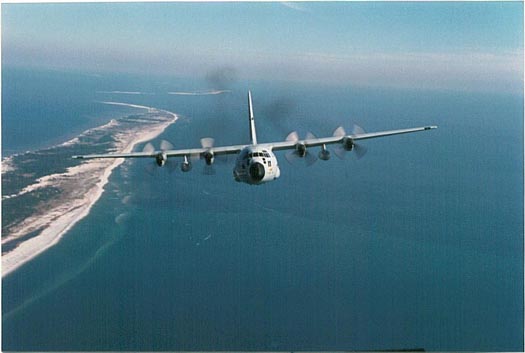
The WC-130 aircraft looked frighteningly huge as it ascended over the waters of the Mississippi Sound. How could something that large, flying at what appeared to be such a gradual pace, make it off the Keesler Air Force Base runway and over the beach highway in Biloxi without falling out of the sky, I used to ask myself?
They seem too big and slow to fly but they do and those of us on the Gulf Coast are grateful that they do.
I never really thought that much about what the planes were doing or where they were going. Nor did the fact that I only saw these planes fly so languidly when I hung out on a hot summer day with my friends provide a clue as to the aircrafts’ missions.
I knew, back then, that a lot of different activity went on at Keesler. I got my first pair of glasses — black, horn-rimmed ones which several later would look cool if you went for the Elvis Costello look— at Keesler because the dispensary at the Seabee base didn’t have an opthamologist or even an optometrist.
My homeboy, Jonathan, who lived with his first wife and then-baby girl over in Biloxi, attended air traffic control school at Keesler during a hitch in the Air Force. After I got back from Sea duty, one of my office subordinates on the ship transferred to Keesler to attend Chaplain’s Assistant school even though he was in the Navy.
But only years later would I figure out that those huge, slow planes that I saw at some time during summers on the Mississippi Gulf Coast beach were so important to my life when I decided to be a p’ert-near coast resident.
Those planes I saw, but didn’t know or particularly care what they were for back then, were Hurricane Hunters.
The 53rd Weather Reconnaissance Squadronat Keesler fly the WC-130s, or Lockheed Martin WC-130J Hercules if you want to get technically anal about it, into tropical systems to detect vital information which helps hurricane forecasters determine what a storm might do and where it might go. Often the Air Force Reserve crews manning the aircraft will fly right into the eye of a hurricane. You might think “calm” when talking about the eye until you remember you have the hurricane surrounding you.
This is one of those days, today, you might see one of these big slow planes take off and ever so slowly climb up into the sky over the Mississippi Sound and its barrier islands. A National Hurricane Center advisory around noon Central Daylight Time indicated an Air Force reconnaissance plane was approaching a low pressure center between Grand Cayman and Honduras. The NHC has given the system an 80 percent chance for tropical cyclone development.
Of course, the cable news media is all over the possibility of a storm like a gecko on an insurance commercial. That is because of the massive BP oil spill that continues to pour into the Gulf of Mexico and onto land from Louisiana to Florida.
My most not-favorite CNN anchor, Rick Sanchez, was making much ado about this not-even-tropical depression and the hurricane “models” which are already predicting paths for what could become the first named storm of the season. If it be comes a tropical storm it would be named Alex. The weather woman on CNN is at this moment as I write this saying which model would be “preferable” as for where the storm may go. She means what would be the best track for the storm, if there is a storm, as it might affect the oil spill and limit subsequent damage, if there is damage and if there is a storm. That is truly putting the dog before the pony show. The reason is that the models of where this storm might head currently extend from Tampico, Mexico, to Apalachicola, Florida. That’s a lot of ground, uh, water to cover and it includes the area in which I live.
In just the last five years I have been through three hurricanes, a tropical storm and four or five evacuations, if you count all those folks who came to this area from Hurricane Katrina until being chased away by Hurricane Rita. If I left out a storm, I apologize.
Don’t get me wrong. I am concerned about the BP gusher as I have been for awhile and not just for the oil-covered pelicans although I hate to see the environment f**ked up. But I am likewise concerned for my neighbors here on the Upper Texas Coast. That is why I am glad those building-sized, puzzling slow Air Force-looking planes I used to see when I was a young sailor are out there flying with confidence in the Gulf of Mexico hunting hurricanes. The information that those airmen out of Keesler gather is important to a lot of people and probably more folks than usual — because of the BP spill in the Gulf — await what comes from the storms that the Hurricane Hunters risk their lives to investigate.