The finer things in life, baloney! Seriously!

Here I sit eating pieces of beef jerky. I have often wondered why is it that I do not find myself in a position in which someone will ask me: “How is beef jerky made?” To which I would answer: “Well, first you start with a very, old cow.”

I couldn’t say if I ate jerky as a kid. I can long remember eating Slim Jims, which are the same as jerky only different.

In many cases there are numerous foods today which were not available to the general public when I was growing up. A major reason for that was or is geography. I grew up in a town of about 2,000 people which was some 60 miles from a “metropolitan area.”

The first Mexican food I remember eating was actually what is identified today as Tex-Mex. That makes sense geographically since I grew up and live in Texas as well as Texas standing next door to Mexico. My mother would buy these enchilada and tamale TV dinners with frijoles y arroz, which we knew, of course, as beans and rice. Although I had eaten at a few Mexican restaurants in Texas and the South, I was never exposed to honesto a dios Mexican food until the time I spent in the El Paso-Juarez area and in Southern California. The first “authentic” Mexican food that I found in a restaurant outside of the Southwest was in Lufkin, Texas, of all places.

First of all, I went to college in Nacogdoches, which was just across the river from Lufkin. Casa Morales was the name of the restaurant. Located in downtown Lufkin, the place had great food and an ambiance to match. As well as a good plate of chile rellenos, one might search through the racks near the cashier for historietas, the graphic novellas which were more lurid and even pornographic than comic. Casa Morales later built another restaurant in Redland, a community closer to the Angelina River that separates Angelina and Nacogdoches counties.

Growing up, pizza was something my mother made with a Chef Boyardee Pizza Kits. I probably first had pizza in a pizza place in high school when I traveled to the Beaumont area, where I now live. Since that time I have eaten pizzas in the northeast U.S., Chicago, the West Coast as well as Australia and New Zealand. I must note, I have never visited New York, though I have had so-called “New York-Style” pizza.

There was some standard fare growing up. My mother made wonderful fried chicken. I remember her fried tripe was excellent although some people I know might gag at the sound of the entree. By the way, I had some really good menudo the last time I stayed in El Paso with my friends. Menudo is known, of course, for its magical powers as a hangover cure though I didn’t eat it for that reason on that particular occasion and it was still delicious.

Other dishes from my mother’s hands included, probably my best-loved dish that she made, her pigs-in-a-blanket. This was long before I heard the term kolache, but this was very near what her pigs were.

We were country folks and as such we would eat some dishes not-so-mainstream growing up. One of my sisters-in-law told of her being stunned to see on one of her initial visits, served on my family dinner table, a cooked baloney. Of course, that is considered soul food in some parts of the country today. My Dad, himself a good cook having served as a merchant marine steward in WWII, would buy a billy goat for the 4th of July that he would barbecue. The meal, especially using meat of a kid goat, today is known more by the Mexican method as cabrito.

I would be remiss not to mention a concoction my dad would make that he called “Son of a Gun.” Now my brothers and I have discussed this many times although I am not sure we arrived at a collective agreement as to what this meal was and what all it contained. Some of my siblings said it was my Dad’s version of “Sonofabitch Stew,” the old cattle drive fare that included just about any ingredient of a cow or other edible meat and lots and lots of hot sauce. But this stew my Pops whipped up was more like a Slum Gullion Stew, which is a watery stew of practically any ingredient handy.

In my Dad’s case, this thin stew consisted of potted meat and some type of canned tomato product such as tomato sauce or tomato soup or perhaps canned tomatoes. I surmise he added hot sauce, salt and pepper and he would often bake up some homemade corn bread as a side. It was truly some righteous stuff.

I have eaten barbecued monkey meat on a stick in the Philippines. I added an egg to a hamburger in Australia but turned down the “beet root.” Today you can get just about any kind of meat or vegetable depending on how much you want to pay and how far you want to travel. But sometimes the simplest meals one may find are the things no farther than one’s pantry or local grocer store. It is all the better when you know the food is made at home, and for love just as it is prepared for sustenance.
The state seizes Beaumont school control. The circus has left town.

The state board that oversees public education in Texas announced today that an appointed board of managers will rule the troubled Beaumont school district.

A letter from Texas Education Commissioner Michael Williams to the Beaumont Independent School District superintendent and school board said the managers along with an appointed conservator and superintendent will run district functions effective June 15. This means the current elected board and its appointed superintendent, Dr. Timothy Chargois, will cease supervision of the largest district in Southeast Texas. A copy of that letter is here.

The announcement comes in the wake of years-long controversy, often based along racial lines, over financial and other mismanagement. Some of the former has resulted in the alleged disappearance of  millions in public dollars. A few pleas by district officials made in federal court may result in prison time as well as financial reimbursement and fines. A deal was also worked out by federal prosecutors and the district’s electrician in which the latter will receive no prison time for allegedly bilking the district for more than $4 million.

A Texas Education Agency report released earlier this month noted ” … a severe breakdown in the management of the district’s finances both by the board of trustees and the superintendent.”

Additional criminal investigations by local law enforcement and the FBI are currently under way.

Not addressed in these official reports are the racial overtones that pervade the controversy. Some of the racial discord dates back more than two decades in which the school district incorporated predominantly black schools and marked the beginning of a “white flight” that has today left Beaumont as a city with a black majority in population. Population estimates for 2012 by the U.S. Census show Beaumont with a population of 118,228. Of that population, 47 percent is black and 40 percent white.

Much of the racial-driver controversy concerning Beaumont schools teetered in the shadows until recent years under the district’s predominantly black school board and its black former superintendent Dr. Carroll “Butch” Thomas. Before Thomas retired in 2012, his salary of more than $360,000 was the highest in Texas. This despite Beaumont ISD was not even in the top 20 Texas schools in enrollment size.

The zenith of the BISD controversy came about after voters in 2007 passed a more than $380 million bond issue. Some of the most vocal critics say Thomas and cohorts mishandled funds in the bond issue. The large “Carroll A. “Butch” Thomas Educational Support Center, with a 10,600-seat football stadium at its center, is perhaps the monument for the BISD storm that either saw its peak today with the state takeover or whatever else is to follow.

Within the fight against the school board has been a vocal minority led by white residents of the district’s more affluent neighborhoods as well local Tea Party activists. The opposition leaders include one of the few white school board members and one local attorney who serves on the Beaumont City Council. Many who are among the most vocal, and often the most racial, can be found at the board meetings and on the comment sections of local media stories. Often the most vocal make their thoughts known pseudonymous online, such as adopting racist names for Beaumont school leaders as well as making sure minorities in other stories are likewise not given the benefit of doubt for their actions.

I must admit, it was once fun watching the squabbling on both sides. But no longer is that the case. Many of the opposition to the school board and its appointed leaders Thomas and Chargois, will feel vindicated and perhaps even giddy upon the actions taken today by the Texas Education Agency and its distinguished commissioner, Mr. Williams. It is pertinent to point out that Williams, who is a Republican former Texas Railroad Commissioner, is also black. I fear though that if the white BISD opposition does not get out of those appointees what they want, the vocal minority will likely point at the black TEA commissioner and probably at any African-Americans he appointed to the board of managers. Perhaps even, the loyal opposition may show its ire at the whole group.

If such takes place, it can only result in more discord and more white flight.

A word for the media here. I am sure all the local TV stations will claim their role in this hoped-for correction of the district. The TV stations are already doing their annoying “It was first reported here … ” The local newspapers took a very, very slow start into covering problems in the district as did the TV stations. Were it not for several of the aforementioned ringleaders of opposition, the media coverage of the district problems would have been nil. Had these media outlets been competently led, they might have seen Pulitzer or Peabody prizes in their future. While I would be willing to bet the TV and newspapers may win some prizes, the awards will be nothing near what they might have been had the local media been on the ball. It’s even possible these problems would have never even come this far.

So much for the fun and games. The circus has long stopped being fun. The clean-up crew now has to try and sweep away all the crap that the clowns, rather than the elephants, left behind.


March Madness turns to white bass fishing in East Texas

My interest in March Madness ceased on Sunday evening. The reason is simple. My team was beaten.

That my team, the Stephen F. Austin Lumberjacks, lost to UCLA is not a surprise. The Lumberjacks had never journeyed beyond the first round before Friday. That was when the team from Nacogdoches, Texas, shocked the hell out of a lot of folks in their mind-bending overtime win over fourth-seeded Virginia Commonwealth. This is only the second time SFA had gone to the big dance.

The Bruins practically invented college basketball or sits as its master of the sport. UCLA hadn’t won it all lately so they got themselves a new coach. So did Stephen F. Austin.

UCLA had height, and a lot of it. SFA were relatively little people compared to UCLA.  But SFA had heart. They had soul. They had a long-haired boy called “Sunshine” who wore tie-dyed shirts when not attired for basketball. Oh, and he likes to hunt and fish. He told one sports reporter he liked fishing for white bass on the Angelina River. Yes, that boy,  Jacob Parker, is the real deal if he knows about white bass and the Angelina.  This time of year the white bass make their “run” along the Angelina.

My friends and I used to hang out at a place on the Angelina known as Shawnee Landing. The property actually belonged to the U.S. Forest Service and was a nice little place to come hang out, go fishing, drink a beer or fire up a doobie. Unfortunately, too many found the place and made Shawnee too good of a thing. I don’t know if it’s closed now or not. All I know is it’s a kind of place where long-haired country boys like to go. I used to take all country roads — one was barely paved — to the place from my house. And on days I’ve had like today, I sure miss that part of Nacogdoches County and those times.

Well, ol’ Sunshine will be back next year and so will many of the ‘Jacks who brought them to San Diego for two rounds of NCAA tourney hoops. Hopefully, the Jack’s now second-year coach Brad Underwood will find him some big ol’ boys taller than the ones he’s got and who can shoot. Meanwhile, the Jacks are back home and Sunshine is probably out fishing. Let’s hope so. The boys, the new “media darlings” at the big dance this year, are Jacks who are back in Nac. Take me home country road.

It’s not a bad place to be.

The days of grocers past

Does anyone remember the jingle: “Let’s go to Henke’s now, Henke’s now, Henke’s now … thrifty place to shop.”

Well, the song is a lot like the one you hear or may have had heard in the past that goes: “Let’s go Krogering, Krogering, Krogering … “

It’s all the same and with a reason. The giant grocer Kroger bought Houston-based Henke & Pilot chain the same year I was born, in 1955. The Henke name was no longer used beginning in 1966, or there about. Although the jingle seemed to hang on.

I suppose if you are under 30 and grew up in the U.S., most grocery stores have always been a constant. I know the grocery chains in East and Southeast Texas haven’t seemed to change much over those years. Where I live, in Beaumont, there aren’t a lot of grocery choices. There is Kroger, of course. Two larger regional chains seemed to have elbowed out any potential large competitors with the exception of Kroger. H-E-B, which was once pretty much a Central Texas chain has grown like crazy and even some of the smaller towns around here have mid-sized or small versions of its stores.

H-E-B has mega-stores in different locations in the state. Two were built when I lived in Waco. There is one humongous H-E-B in Beaumont on Dowlen Road that anchors a small strip mall. When it first opened it featured a small “Central Market,” which is the company’s gourmet grocery chain. One may find all the hipsters at the Central Market in Austin (that should be ‘Markets,’ and they are littered with ‘foodies’ in major suburbs like Plano and Southlake in the DFW area.) I will give the tres chic  H-E-B that it does have many great items one would be hard pressed to find elsewhere.

Unfortunately, Beaumont isn’t a hipster town — at least not in reality — so its H-E-B Central Market was gone and installed was a doc-in-a-box. A new, and presumably likewise large, H-E-B is now solid ground but will be coming up at the site of the old Baptist Hospital at South 11th Street and College. This is next door to the booming Memorial Hermann Baptist Hospital and its surrounding medical village. This is kind of a crossroads of where Beaumont’s  mostly Black, goodly-sized Hispanic and minority White population all have to go at one time or the other. If they don’t go to Baptist they usually go up 11th to Christus St. Elizabeth or to Texas Medical Center in Houston.

Of course, the “Golden Triangle” also has an abundance of Market Basket stores. It is a chain in Southeast Texas and Southwest Louisiana some half-century old, based in Nederland, Texas, that has seemed to do just fine.

Various other stores either went out of business or got bought out. The Brookshire Brothers chain, based in Lufkin, can be found pretty much in the Big Thicket and Deep East Texas areas. The company has also moved into areas of east Central Texas and parts of Central Texas as well.

One need not mention Wally World.

I think about some of the stores that were once here in Beaumont: Albertson’s, Gerland’s, gosh knows who else. In Nacogdoches, where I spent a great deal of my life, Safeway was once a huge, unionized store. Kroger was also unionized there. One of the first girls I dated upon first moving to Nac, I met at Safeway. Those are the kind of memories one likes to have of a grocery store instead of getting stuck in line to no end. The Safeway girl and I parted quicker than some of those lines, I would suppose. But we left amicably as she wanted to move back to Houston and I said, well, if someone wants to move to Houston then I guess I have no great opposition to it. I was fine just where I was at that time, and several other times.

Also I remember the little East Texas town from where I came. We didn’t have any of those big-named stores. Maybe a couple of years after I left a Brookshire Brothers came. It was a familiar brand because my uncle Sox retired from the company. Uncle Sox then worked part-time after retirement in a little town outside of Lufkin called Huntington. Uncle Sox worked for Boots store, named after a man called Boots. Sox and Boots. Seemed kind of proper, yet still gets a big family chuckle.

Some of the small-town stores I remember delivered. Dick’s Grocery, whom I am named for (Dick, not Grocery), used to set their fruits and vegetables out on the curb. I remember one store, owned by Ira Bean, sold a little of everything. Then there was Joe Harrell’s who we saw for smoked meats and his homemade sausage. And like family was J & J’s, the corner store, but not like in a convenience store. I remember they had a big old wheel of cheddar sitting on top of the butcher case. John & Juanita were as good of people you could find.

Man, those were the days. Well, excuse me because I have to go to Kroger’s. Have a great weekend.

Some heroes gets their rewards and others get, something else

EFD Celebrates 2,500 posts since 2005. Weird huh?

It was nice, if only for a short time, to view something on TV news other than blatant speculation over what happened to Malaysia Airlines Flight 370. I speak of the somewhat solemn ceremony that is taking place in the White House as I write this. Of course, the airing of the ceremony on CNN didn’t last long because Jake Tapper had to come in and talk and talk some more. The White House to do is honoring 24 soldiers from World War II, Korea and Vietnam with the Medal of Honor. These were Black, Hispanic and Jewish soldiers — the majority awarded posthumously — who were originally presented the Distinguished Service Cross. A congressional review upgraded the awards from the nation’s second highest for valor to the top decoration. It isn’t stated on the special “microsite” but because these brave soldiers were Black, Hispanic and Jewish is why they were not originally awarded the Medal of Honor.

First U.S. WWII hero. Dorris Miller, remains without Medal of Honor

It is always a glimpse at a real hero to read the citations for the MOH dating back to the Civil War. Well, some may argue that certain ones didn’t deserve the award. Read the citations and make your mind up on your own. And, it’s certainly not to say that a few of the awards are, shall we say, unusual, such as the Unknown Soldiers of Rumania (now spelled Romania) and Italy, both from World War I.

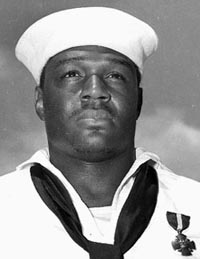
Speaking of unrewarded heroes, which we were, I see there is a development in getting additional recognition for perhaps the first American hero of World War II. I wrote a story more than a decade ago as to how locals in the Waco, Texas, area had made a push to upgrade a Navy Cross — now the Navy’s second highest — to the Medal of Honor. The award was third highest behind the MOH and the Navy Distinguished Service Medal when Cook Third Class Doris Miller received the medal.

Miller was a Black farm hand from the Waco area when he joined the Navy in 1939 and ended up as a mess attendant and cook, one of the few jobs open to African Americans back then. Miller, called “Dorie” by his shipmates, was stationed on the battleship U.S.S. West Virginia berthed in Pearl Harbor on Dec. 7, 1941. Miller responded to the attack along with shipmates. Miller helped move the ship’s captain, whose wounds proved mortal, to a place of greater safety on the bridge. Although he had not been trained to fire anti-aircraft weapons, Miller took over such a gun battery and began shooting at Japanese planes. Stories passed down through the years say Miller even shot down one of the planes, though it was never proven. Miller was portrayed in the 2001 movie “Pearl Harbor” by Cuba Gooding Jr.

There remains a long-held notion that Miller would have been a Medal of Honor recipient had he have been white. To the day, the effort to have Miller nominated for the MOH has failed. It is most fitting, though not a substitute for a Medal of Honor, that the Republican U.S. House member, Rep. Bill Flores, who represents that area of Central Texas, is leading an effort to have the Waco Department of Veterans Affairs Hospital named after Dorie Miller. I used that facility for my VA primary care for some seven years. And I believe that I played a pretty major role as a journalist in keeping the facility from closure. I know that sounds conceited and probably is. But it is nevertheless the truth. The publication I wrote for back then has the hardware to prove it . That isn’t taking anything from them. Papers like rewards and they got recognition for my work and that of a couple of others.

Okay, so now what? We go back to endless coverage of Flight 370? It is a mystery, though one wonders how long it will sustain the coverage cable news is giving it? Only fate and the suits know for sure. So until next time, … “All Right. Good night.”