Isaac. Don’t worry about the forecast track folks, NHC says. Panic!!! Just kidding.

Work has kept me away from the blog lately. A schedule of 36 hours on five days of work also awaits me this week depending on what Isaac (not Hayes) does. I have been keeping my eye on this storm for awhile now and even more so since one of the more reliable computer models has Isaac landing smack dab into the land of EFD. (That’s eight feet deep in case you didn’t know.)

A number of the so-called “spaghetti models” are split between here, there and everywhere. The last two major hurricanes I have experienced involved the National Hurricane Center’s forecast “inching” up the coast until about the day before the storms hit. No fault due the NHC, but what’s a po’ boy to do but pull a solution out of one’s a**.

It is never a good time for a hurricane. It is especially a bad time for one to hit near me due to my precarious financial situation. Perhaps I could get the go-ahead for some freelance work. I don’t know where I would plant myself in the event of a storm. I guess it is as always. This may be the last time for you to donate to the cause if the hurricane hits, provided it turns into a hurricane. If I have the finances to keep going during the storm, I will do so and attempt to write about Isaac from my perspective. If the hurricane doesn’t hit here, which I hope it doesn’t, never mind.

Finally, here is the latest forecast discussion from the National Hurricane Center for Isaac. I have the utmost respect for these folks but the disclaimer at the end is just a bit too much:

THROUGHOUT THE PERIOD…IT IS IMPORTANT NOT TO FOCUS ON THE EXACT FORECAST TRACK DUE TO FORECAST UNCERTAINTIES AND THE FACT THAT SIGNIFICANT HAZARDS EXTEND WELL AWAY FROM THE CENTER.

Uh, pay no attention to that man behind the curtain? Maybe it’s just me.

Here comes the rain again. ZZZZZZZZZZZZ

This morning the rain was falling down on my A/C. It is rather hypnotic, the rain. I really don’t know how to describe it. “teettle, teettle, teettle … ” and so forth. That isn’t a big rain, mind you. Merely found if you wanted to get up and look falls just enough drizzle to keep you in bed and not wanting out. And excuse me for being human but bonus points for having some good ol’ gal next to you who doesn’t talk about the hypno drip-drip-drip outside.

Yes, rain is romantic. It paralyzes. It puts one under. The great, wet anesthesiologist, Dr. (or CNA) Drip-drip. Not to be confused with the college clinic doctor who treated clap.

Unfortunately, I had to get up and go to work. I hear the rain may make a command performance this evening. That wouldn’t be bad at all provided the person who impersonates an elephant living right above me is out doing his/her/its shift work thingaroo. Just thinking of all this is making me sleeeeeeeeeeeeeepppppppppppppppyy …


Weathermeister: “We’re not out of the woods at all yet.”

Our local Channel 6 Beaumont weathermeister, Greg Bostwick, errs on the side of caution most times when hurricanes are concerned. He seems to think Tropical Storm Issac could might possibly may hit more of a western track which might put it somewhere in the Southeast Texas area. “We’re not out of the woods at all yet,” Bostwick said a few minutes ago. If I didn’t quote him exactly sorry. You get the drift. Or will.

Greg has been at Channel 6 for, I don’t know, a long time. He is the best TV weatherman or weatherperson in the greater (as opposed to not greater) Beaumont area. He comes off sometimes as a bit full of himself. That can happen when someone is for a long period, the cock of the walk or vice versa. I guess I can’t blame him no matter how much he annoys me at times.

All of that really doesn’t matter when it comes to hurricanes. Bostwick seems to stick his neck out sometimes when I don’t think he should, as in saying, no way Jose. Somehow I can’t imagine him saying that, by the way. But when he does sound cautious on the side of an approaching storm. I listen a little bit.

And I keep a close watch on the National Hurricane Center, the spaghetti models and the Air Force Reserve Hurricane Hunters out of Keesler AFB, Biloxi, Miss.

Do you know what this is? No, then leave me alone.

Do you know what this is?

A common Facebook meme these days, especially among the Baby Boomers, starts with “Do you know what this is?” or “Ever seen one of these?” These questions precede a photo such as drive-in movie speakers or a Slinky, perhaps. From what I have read, Slinky stills remains a best seller. I can understand why. There is nothing like watching a spring run up and down a set of steps. I don’t know why. It just is what it is.

If it is something that doesn’t piss me off, like a Care Bear for instance, then I enjoy playing along with the meme. Some folks don’t appreciate a joke one might make along the way, which I understand. The truth is, not everyone has the same frame of reference.

So I thought I would put up a few photos. Not everyone will recognize them. The pictures are of a specific occupation, firefighting, which I did from 1978-1983. I think most of the objects found — I’m sure some of those — are still used in battling blazes. Fighting fires hasn’t changed that much during the period of time I have been out of the profession although some tactics and gizmos have become much better. I wish some of the gadgets they have today were around when I worked in the profession. Here are a few of the devices we used way back when. And perhaps now.
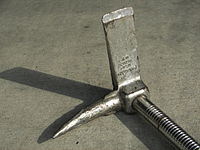
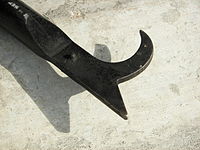
Top of the morning to you! Do you happen to have a Halligan tool handy? We always had certain job-specific tools around, many were made from sheer need. Before I introduce the Halligan, to the right, I will briefly explain the pike pole upstairs and to the left.

From what I’ve found so far, pike poles at least date back to the days of the Cossacks fishing for sturgeon in the Ural River of Russia or Kazakhstan. The Cossacks used the spike of the pole to break ice and pull out sturgeons which were hibernating. It is not exactly the best way to be awakened from sleep but then again, neither is having some galoot whose call happens to be a wrong number. As for as why it was called a “pike” pole and not a “sturgeon” pole, you’ve got me.

For firefighting, pike poles run up to about 12 feet long and are stored on some kind of clip lengthwise on a fire truck in many cases. The pole is good for pulling sheetrock, walls and ceilings apart to find fire. Much can be said as well for the Halligan.

The Halligan, or known as well as a “hooligan” tool, was reportedly named after a New York fire lieutenant in the 1940s.The tool has a pick and claw which can be useful in forcible entry and other purposes, such as helping pry doors apart until the Jaws of Life come. Or if a particularly unruly cop is on the scene who interferes in your services to the public as a fireman, the Halligan becomes a hooligan and once the cop has turned to look away one might give him a pop alongside the head. Just joking. None of that would happen.
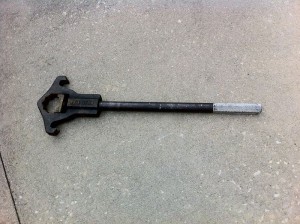
 

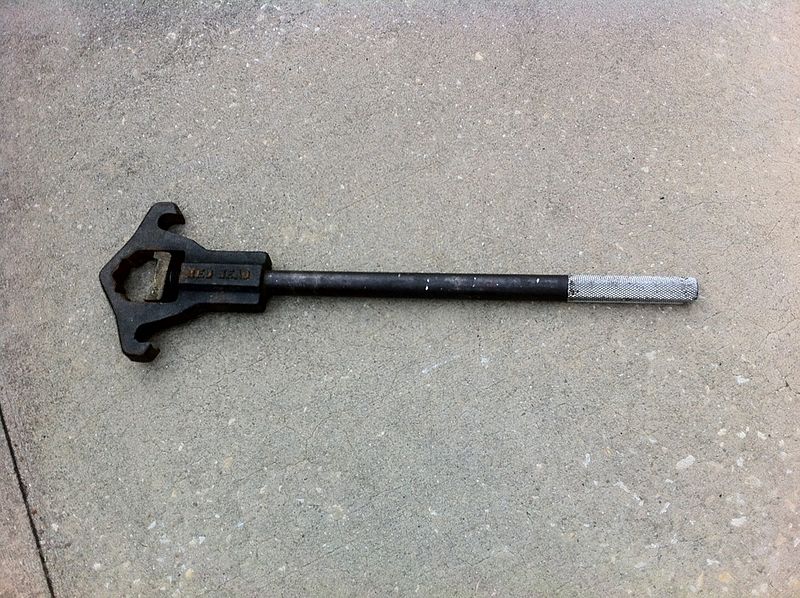
An odd-looking bugger indeed. But if you want more water than is in one’s pumper tank or tanker, then it is the perfect way to turn the top of a hydrant to the “gimme” position. Yes, dear friends, it is a hydrant wrench or key. Notice the long shaft of the tool. It caused me some great difficulties while I caught the “plug” one day as a gasoline truck tank blazed along, threatening an entire gas facility. My path was impaired by a fence and it took me twice as long as it should have to open the hydrant. That made me popular, of course, as the firefighters down the supply line awaited the gushing water from me.


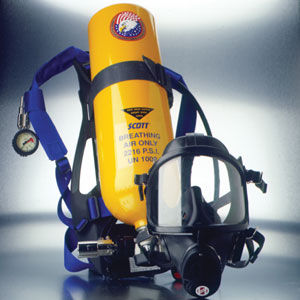
Below you will see the SCBA. Notice the “U” is missing. What happened to the “U?” Who stole it? Where’d it go?
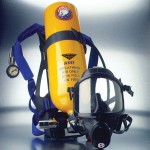
Well, there is SCUBA and SCBA. One is meant for breathing underwater and the other for breathing during fires or other hazardous respiratory conditions. The equipment is called a Self-contained breathing apparatus for firefighting and Self-contained underwater breathing apparatus for SCUBA diving.

There are differences between the two types of breathing equipment. If you want to know about the difference you can start here.

Hopefully you have learned something here. If not, sorry. There are millions of other places on the Internet where one might learn many, many things.


Is reason behind “Suicide by Bridge” similar to that of climbing Mt. Everest?

The old retort as to why does one climb a mountain — “Because it’s there” — may answer a few questions as to human behavior such as that of suicide.

George Mallory was among the climbers during the first three British explorations of Mt. Everest. He was found 75 years after his last and fatal try. Some might ask if one who attempts such a feat has a death wish. Who knows what lurks way down in the recesses of thought. Those who have made the trek to Everett successfully may often appear, at least, to have a zest for living.

Such a dark subject often surfaces in certain communities when someone takes a suicidal leap nearby or if the leaper was a prominent person. The last describes the death ruled by authorities as suicide of Tony Scott. The director who was known for such movies as “Top Gun” and “Beverly Hills Cop II” died after jumping off the Vincent Thomas Bridge. The structure, which spans Los Angeles Harbor, is the fourth longest California bridge. Oddly enough a witness saw Scott ascending the cables in a “determined” fashion, which indeed raises some added mystery in the 68-year-old’s death since he was a known rock climber.

This “suicide by bridge” method of killing oneself  fascinated me for a number of years. Part of the reason is that I have a strange attraction to bridges, that after suffering in my younger years with a fear of heights. I suppose I also have somewhat of  a morbid curiosity. My familiarity with the Vincent Thomas Bridge also piqued my interest in this particular case although I was familiar only with one or two of the director’s films.

I traversed the Thomas, an aqua green suspension bridge, almost daily for the first two months of my life as a sailor on board a Navy ship. My ship was like a fish out of water, pardon the pun, as it was dry-docked in Todd Shipyards on the western end of the bridge in San Pedro, Calif. Nearby and quite visible was a terminal for boats headed for Santa Catalina Island as well as cruise ships such as the Pacific Princess, a.k.a., TV’s “Love Boat” during the time.

The Veterans Memorial Bridge, completed in 1990, runs parallel to the historic Rainbow Bridge over the Neches River and Sabine-Neches waterway. With a 143-foot vertical height — almost 35 feet shorter than its neighbor — it was the first cable stay bridge built in Texas. Photos by Aren Cambre courtesy of Wikimedia Commons

While in the yards we worked four 10-hour days each week and enjoyed a 3-day weekend off to explore LA, Hollywood and beyond provided we didn’t have duty. And duty was the only day we slept on the ship. We drove, those of us with cars like myself, after knocking off to what was back then Naval Station Long Beach on the eastern side of the bridge.

It was an interesting experience driving across the Vincent Thomas, as one could see the bustling industrial economy of Southern California from a birds-eye view. One morning I drove across it going to work and found one of the lanes blocked off. At the top, I discovered the closure was because of filming the 70s TV show “Barnaby Jones,” which starred Buddy Ebsen. Over many years I have recognized the bridge in numbers of film and TV episodes.

Here in Southeast Texas are found a pair of twin bridges that seems to attract suicidal people from time to time. Such structures even have a rather unflattering nickname as “Suicide Bridges.” I have no idea and have not found any data to show how many people have met their deaths from jumping off the almost 75-year-old Rainbow Bridge and its younger adjacent Veterans Memorial Bridge. Needless to say, it is not totally uncommon to hear of those who will just stop their cars on top of the bridge and leap to their deaths.

I am sure I would get an argument from folks debating the reasons and justifications or unjustification of taking one’s own life. And while interesting wondering the reason why one chooses a so-called “landmark bridge” to take a final Swan dive off, certain studies explain  the reason for jumping off those bridge could be as simple as why a mountaineer climbs a mountain. Yes, friends, because it is there.

Studies examining the effectiveness of barriers on bridges to prevent jumpers have failed to find a correlation between preventing suicide on a particular bridge and lowering a community’s suicide rate altogether. These studies looked at such possibilities as the therapeutic qualities such a structure holds to a belief that diving off into water from a high bridge wouldn’t hurt. Obviously, such attempts are not always well thought out and are thus spur-of-the-moment acts.

As social science many times finds, the answer to the most puzzling questions are often the most simple or trite answers lying around for the rest of us lazy researchers to uncover.

Note: This blog is in dire need of donations. Actually, I am. If you want an explanation, send me an e-mail. Otherwise trust me. Things are as tight at the moment as they have been in years. Hit that Donate button and help out if you can. I thank you and my blog-typing-fingers thanks you.