SE Texas-based Jason’s Deli tops Zagat health category

That I ordered a sandwich today at Jason’s Deli — at the Original, as in first-ever Jason’s Deli — had nothing to do with the Beaumont, Texas,-based restaurant outfit being named by the Zagat consumer survey as best large chain with healthy options. In fact, it was downright depressing when I later looked up the “New York Yankee,” the sandwich I ordered, on the company’s online nutrition chart. I nearly fell out of my chair when I discovered the tasty pastrami and beef on rye carried with it a whopping 69 grams of fat and 1,189 calories. Thank goodness I have started eating Healthy Choice frozen dinners at night lately.

Billed as the “Gastronomic Bible” by The Wall Street Journal and its own PR people as “the world’s most trusted source for consumer generated survey information,” Zagat released its annual fast food survey today.

I try to choose from the much lighter Jason’s menu but light gets old in a hurry. Plus, I’m a Jason’s junkie. Having a great deli company like that based in your neighborhood is good okay, kind of like wicked fine only mo’ better.

Subway won that same category in the “mega-chain” group. The ‘way is, of course, famous for its different sandwiches under 10 grams of fat and which made Jared skinny. I eat at Subway too. However, Jason’s offer more than just sandwiches. Probably my favorite Jason’s is the “Quarter Muff Special” which includes a quarter muffuletta that is about the size of a double-meat Whopper and includes chips (I go for the Baked Lays), a pickle and a cup of soup. My soup “cup” of choice is actually a spicy and delicious seafood gumbo.

Likewise, Jason’s has breakfast items which I have yet to taste in the 15 years I have dined at the chain. They have one of the best salad bars to be found anywhere. Regardless of whether I eat at the salad bar or order something else I usually pickup about a handful of assorted nuts from their salad bar. J’s Deli also features all types of wraps and spuds and soups, as I’ve mentioned. I love their Black Currant Tea although they have several other types as well of other refreshments. I suppose they still sell beer at the original Beaumont stores but I am not certain. I haven’t noticed for a long time. Since lines tend to get long at both their Dowlen Road location and the original at Gateway Shopping Center off South 11th, it is quite handy they have a kiosk where you can use your credit card to get a salad bar order. Just step ahead of the crowd, place your order, swipe your card and get a big bowl from the counter.

A Jason’s Deli meal most times averages around $10 if you have a drink with it. Closer to $8 if you only want some iced water. Even though I think their tea is unmatched in most places, at least in this part of the country, I still think $2 is a little steep. Of course, you can refill and the dilligent and most times smiling Jason’s folks will cheerfully hand you a “go cup,” which is very useful in these scorching Texas days we have had lately.

I have to say I can’t agree with a lot of other Zagat survey choices. The news release announcing their survey gives the particulars:

 “This year’s survey covers 103 chains as voted on by 6,064 diners. The typical surveyor dined at a fast food restaurant at least once a week. They weighed in on everything from breakfast to burgers and fries to frozen yogurt, separately rating each chain on the quality of its Food, Facilities and Service on Zagat’s signature 30-point scale as well as ranking their favorites.”

Still, some of those joints they weighed in on — some of which I may visit every now and then — are kind of baffling. I get the popularity contest of the top five mega chains, 1st to last, Subway, McDonald’s, Wendy’s, Burger King, Taco Bell. The top “overall” ratings which include service, food and facilities for mega-chains are 1. Wendy’s 2. Subway 3. McDonald’s 4. Pizza Hut 5. KFC. That, my friends, is truly mind-blowing.

The survey did unveil some clever comments from the respondents and some appear as if they might land pretty much on the mark for some spots:

  • Rule #1: don’t look inside the burrito
  • Helping generations turn into obese diabetics
  • Consistently awful everywhere, but at least you know what to expect
  • They even fry the napkins
  • Major food groups are well covered: grease, salt and burned
  • Always entertaining – usually a brawl or arrest to watch
 

A little Labor Day randomness

Tropical madness

It would probably sadden me to determine just how many of the 1,975 — this being No. 1,975 — posts which I have published on this site dealt with weather. I counted 10 thus far in 2011 alone. My possible sadness comes from my own consternation over the countless paragraphs I have written over the past three decades, most in newspapers, concerning the weather. Now those stories I have written since I began freelancing six years ago do not count because I was paid by the story rather than a salary.

Quite frankly, I think newspapers — the ones I worked for at least — often publish needless stories about the weather. If it rains after a long drought, okay, it’s more than likely news. If it comes a thunderstorm with no damage or power outages or anything more than a lot of rain and lighting when such a storm is normal, I don’t think so.

The truth is though, that weather interests me, a lot. I may have mentioned here that I wanted to be a TV weatherman (we didn’t call them “meteorologists” back then) when i grew up. I guess I became one in a way, writing news stories about the weather, I just wasn’t on TV.

Weather is also most likely the one facet of life which affects everyone in one way or the other. Do you want to know how to dress for work tomorrow? Are you planning on an outside gathering or a job or perhaps even working at all? You check the weather or if you don’t, you probably go outside and look at the sky! These are just the obvious concerns one has most every day about climatic conditions.

Among the many other reasons for considering the weather:

*Voter turnout in elections

*The price of food

*The price of gasoline

*Local traffic

*Air travel, both locally and nationally

*The stock market

*Recreational economies

*Crime

The list goes on and on. So perhaps my aversion to “meaningless” weather stories was a little wrong-headed. Well, I will concede that is true in some cases but not so true in others. What is meaningless is doing a weather story — like any other — without meaning. Nevertheless, when the boss tells you to do a story or dig that ditch or make a silk purse out of a sow’s ear you usually do it. That is, you do it if you want a pay check.

With that very long explanation, just a brief mention that the Beaumont area did get some rain out of Tropical Storm Lee despite the repeated lines by The Weather Channel people that Texas was not to receive any beneficial rain from the storm which for quite sometime was no more than about 80-to-100 miles off the coast from where I live.

It is true, the majority of Texas received no beneficial rain, if any. Today, huge fires have burned several hundred homes in the Bastrop, Texas, area just to the southeast of Austin and there are other wildfires blazing in the parched state. But we received a little rain here in Southeast Texas, perhaps near 2 inches where I live. Plus the gusty winds and the clouds kept the temperatures down to highs of about 75 degrees. That was worth a weather story alone, considering we have recently experienced 100-degree-plus temperatures.

CollegefootballCollegefootballCollegefootball

College football swirling down the toilet bowl

The supposed departure of Texas A & M from the Big 12 Conference to the SEC has once again set in motion a major shakeup in Division I alliances. Now there is talk of Texas, Texas Tech, Oklahoma and Oklahoma State splitting for the Pac-12.

College football has long been about money, some of it legit, some not so legit. Now these threatened departures smack of nothing more than greed. In the case of Texas, Tech and A & M, I can’t help but think that the defection from the Big 12 of these state-run universities with regents appointed by our own Gov. Goodhair may have a major political angle as well. Okay, go ahead and say “duh” or “ya think?” Nevertheless, money and politics, politics and money, we may see the end of Texas and even national Division I football as we know it. Many of these proposed alliances just do not fit. Think about it. You’ll see that I am right. Because I am always right and I never lie. (Apologies to Firesign Theater)

AFLCIOAFLCIOAFLCIOAFLCIOAFLCIOAFLCIOAFLCIOAFL

The reason for the day off

It is Labor Day. This day traditionally marks the end of summer and some great sales by giant retailers. But the holiday itself is about honoring the workers of this nation. The holiday is rooted in the original labor councils of the late 19th century, the forebears of today’s AFL-CIO.

The right wing has made an all-out attack on labor since the Tea Party-led Republicans gained a congressional majority. That is why it is important for organized labor to continue to drive home the contributions the unions have made to the American worker such as those in this reminder by the AFL-CIO:

 “Unions have made life better for all working Americans by helping to pass laws ending child labor, establishing the eight-hour day, protecting workers’ safety and health and helping create Social Security, unemployment insurance and the minimum wage, for example. Unions are continuing the fight today to improve life for all working families in America.”

I have had the honor of membership and serving as vice president in two different union locals which were, respectively, affiliates of the International Association of Firefighters and the American Federation of Government Employees. The contributions and assistance both organizations made to my fellow workers were of great benefit to both non-members and members. I have a number of friends in the trade unions who have made very good livings for themselves and their families both financially and through benefits such as health care and retirement. Like the old Neil Young song: “I’m proud to be a union man.”

Whether you belong to unions or you hate unions, your life has been enriched by organized labor.

With that, I wish you a happy Labor Day.

Uh, that’s TROPICAL STORM LEE we’re now talking about!

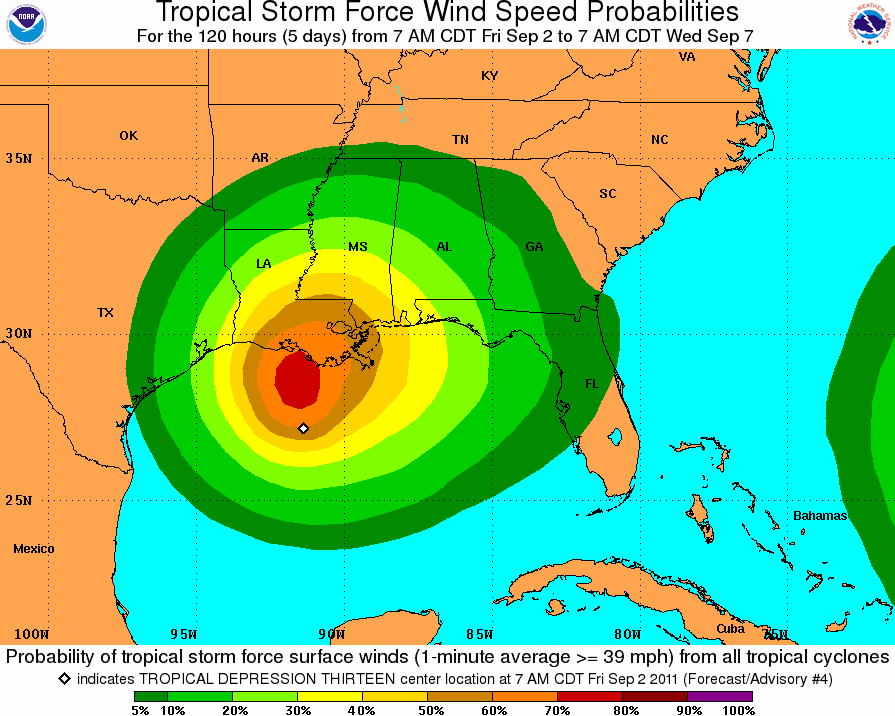
Yes, it is no longer that oddly-shaped tropical wave out there in the Gulf. Nor is it TD 13, meaning Tropical Depression 13. The National Hurricane Center upped the storm’s status to Tropical Storm Lee this afternoon and it appears to threaten New Orleans with a lot of wind, a lot of network reporters and probably a great deal of hype. Perhaps I am being a tad redundant.

The national media, at least the electronic media, seem to have an obsession with New Orleans. Who can blame them? Who wouldn’t want to go to Fun City on an expense account? Who cares if it’s raining or the wind blowing? A real storm would be just great, then the reporter could go out and do a Dan Rather-style standup in the howling wind and rain, then dry off in the truck and haul ass to Pat O’Brien’s for a little French Quarter-style hedonism.

I am being somewhat facetious here and even more than a bit cynical.

What I see as a media obsession didn’t just start with Katrina. As long as I have been associated with journalism, what I call the “New Orleans Media Obsession (NOMO),” has been evident. Katrina was a journalist’s gift that fed NOMO and that kept on giving.

That is not to say Katrina was not a compelling story. It was and it remains that way, to some extent. But a lot of folks which suffered their own disasters and felt their own losses got tired of NOMO and wished they’d hear no mo’.

To survivors — if you want to label them as such — of latter storms such as Rita and Ike, New Orleans is a damned touchy subject.

It isn’t that those who suffered their own loss or went through the unpleasant experiences of a hurricane cannot empathize with a magnificent American city which lost hundreds of people and places and much of its soul during Katrina. Rather, they wish the media had also been there in smaller places like Cameron and Sabine Pass and Bridge City and even towns 70 miles inland after Rita. Sure, the media were there when the “optics” looked good. But when people were sweating and beginning to smell a little ripe and were a bit weary and even bitchy, where was Anderson Cooper then? Why he was doing a standup in front of the St. Louis Cathedral, right next to Jackson Square and facing the mighty Mississippi.

The national media going where the largest number of people are involved is something that most folks should understand although many probably do not. New Orleans and Katrina involved something unparalleled in modern U.S. history. But forget the hinterlands for a moment, not nearly as much attention was paid to the Mississippi coast either where Katrina killed several hundred people and some places were wiped off the map.

So New Orleans could get 20 inches of rain — perhaps over several days. In our drought-ravaged southeastern corner of Texas, we wish we could get a little of that rain or even more than a little.

The truth is no one can say for sure what Lee will do next. The spaghetti models have been thrown against the walls every which a’ ways. The confluence of Texas and Louisiana at Sabine Lake isn’t expected to get but between a half-inch to a couple of inches of rain at that. It’s expected to be pretty windy because of Lee for several days. That will at least keep these hotter ‘n hell temperatures down a bit.

We really don’t know what will happen until it happens though. Pretty much every hurricane I’ve seen hit our area was originally forecast to make landfall as much as 100 or more miles away. Science has thankfully become better at predicting hurricanes, and the National Weather Service cannot overemphasize that people should not rest their focus on where the center of a hurricane hits because there are way too many variables which affect the dangers and potential damage of tropical systems.

So stay tuned. If it looks like rain, perhaps you might consider getting out of it.

Or not.

I can’t drive 65

If you find yourself on a Texas highway this evening, the night of Sept. 1, 2011, or afterwards, feel free to drive 70 mph if you see one of those signs which indicate a day speed of 70 mph and 65 mph at night.

Well, hell, you would do that anyway. People tend to drive at least 5 mph over the speed limit, and then some. So go ahead and drive 70, or 75. That is because tonight the official posted speed of 65 mph is a relic of the conservation past.

Our Texas Legislature, in their infinite wisdom (that’s a joke, son!), passed a law during the last regular session that:

”  … eliminates the 65-mile per hour nighttime speed limit and all truck speed limits,” says the Texas Department of Transportation, a.k.a. TxDOT (pronounced th hi’-way de-part-ment Tex-dot.) “On September 1, the existing nighttime and truck speed limits are repealed and no longer enforceable.”

No more 65 at night. What will they do with all the old signs?

That doesn’t mean you should get all indignant and up into the face of a big ol’ cop named “Billy Bob ‘Bubba’ Hayseed.” Says our local PR flak for the Beaumont district of TxDOT:

“I wouldn’t take my chances with someone just itching to write you a ticket for the sake of giving you a hard time,” said Marc Shepherd, TxDOT public information officer. “Of course, most, if not all law enforcement agencies know about the new law and the fact a ticket probably wouldn’t stick.  I’ll leave that up to you, your lawyer and the judge.”

That same law also allows the state to create a 75-mph speed limit provided the highway has undergone a study and is ruled “reasonable and safe.” This is not supposed to happen over night either. But once again, since most motorists driving 70 mph already drive 75 anyway it just cuts down the quasi-legality of an 80-mph speed limit on that highway.

I am not an attorney, nor do I play one on TV, so the information I present herein should not be considered legal advice nor a suggestion that the reader should break the traffic laws of this or any other state, territorial, federal, local or international government, nor any principality ruled by a monarch named “Marvin the Prince of Sales.”

Speed limits have gone all over the place since I started legally driving almost 40 years ago. The maximum day-time speed was 70 mph in Texas when I first received my driver’s license.  Then about three years or so later, just about the time I was of the age of being in a hurry to get somewhere, the national speed limit was changed to 55 mph. This was done in order to conserve gasoline but it did little good because the majority of the public — more than 80 percent of Texas drivers on interstate highways in one state highway department survey — drove faster than 55.

Frustration over such a slow speed eventually reached the boiling point and prompted rocker Sammy Hagar to record his hit “I Can’t Drive 55” in 1984.

Then sometime while I was sleeping, around 1995, the 55 mph speed limit was repealed. Once again speed limits including those in Texas increased and drivers could legally drive like a bat out of hell once more.

It was probably just before the speeds were increased from the lunatic 55 mph limit since I last drove out to West Texas. I can’t remember what the speed limit was then to tell you the truth. But now, in some of the desolate counties on Interstate 10 between El Paso and San Antonio, one may drive Mach 1 80 mph.

I am sure some folks, maybe some of those who believe we should have little or no government, would be happy with no speed limit. We could motor around in a “survival of the fastest” mode. I don’t like that idea very much though. It is kind of exhilarating to drive a car at speeds of more than 100 mph, even more than 135 mph. I think that is my fastest and it was while driving a car with a police interceptor package. But I have a comfort zone and, depending on the highway and the circumstances, it’s usually less than 75 mph.

Yes, I have finally become one of those “old coots” who drive slowly and impede the progress of drivers behind me. That’s all the while I am driving 75, which — for the time being at least until the studies are completed — is 5 mph over the speed limit. So just lead, follow or get the hell out of my way!

If a tree grows in the forest, and no one is around to hear it, does it still grow?

A drive a couple of days ago into the fringe of the backwoods reminded me that it has been awhile since I wandered alone out into the East Texas forests. There are a number of reasons for that. Right now, the only way to wander is if you are in an automobile with good air conditioning because we have been trapped in freakish 100-plus-degree heat for too long now.

When I say “fringe” I really mean it. The area in which I was riding is within a certified metropolitan area, specifically the one which includes Jefferson, Orange and Hardin counties in Southeast Texas. The 2009 Census estimates for these counties in what is called the “Beaumont-Port Arthur” metropolitan area (Sorry Silsbee, Kountze and Lumberton!) was about 380,000 people. That isn’t exactly the sticks but it also isn’t Manhattan.

Nevertheless, I like places where I have the ability to be out of earshot of any sounds other than that noisy rustling of pine needles in the wind or the occasional obnoxious jackhammer on wood sound of the woodpecker. It is in such areas where I like to sit and think, take a look at nature’s work and try to figure out just how good I have become over the years at determining the type of local trees.

Big Cow Creek in Newton County, Texas.

Now that sounds easier than it really is. I mean, if you grew up in the Piney Woods of East Texas as I did, you ought to know your trees, right? Wrong. I spent a lot of time in the woods growing up and I could tell you the difference between your species of local pines — loblolly, shortleaf, longleaf, or slash. And you’d come to know the type of tree you may have fallen out of while climbing or while swinging from a tire such as a pecan, or oak, or chinaberry. But let’s face it, when you’re in the forest full of trees, especially during the summer when the leaves all form a green canopy, the trees all seem to look alike. That is, they look as such if you fail to take a good look at them.

Driving in the fringes the other day I did see what appeared to be a couple of fairly young bald cypress trees standing on the edge of a creek or bayou. I have seen enough cypress in my years to know you find them around streams with their large fluted trunks and their weird looking roots, or knees, growing out of the water. Most cypress I have seen were old. Some are huge and have been around for more time than we have to talk about.

I learned about pine trees from my brother Billy, who as a young man worked for a timber company before he worked as a career in the refining biz. I even planted some young pine seedlings but couldn’t tell you if they’ve grown or where they are. If so, these trees are between 40-50 years old and could be quite a tree.

In the area in which I was raised, pine was the cash crop. Once, in the time of my parents, one could still see some of the virgin longleaf pine trees which flourished where I grew up. I remember this one picture, it might have been of my Dad, with his arms almost all the way around one of these great trees. But it took awhile to grow these and one could not always find the sandy soil these longleafs needed in many areas outside the little three-or-four county strip in which they grew.

So the timber companies planted faster-growing trees such as loblolly or shortleaf, pine trees which could produce some considerable board feet of lumber in a mere 20 or so years.

This brings up a whole lot of discussion I don’t particularly care to have at this time such as “clear-cutting vs. selective harvesting.” I’m not saying that it is not a worthwhile debate. I just don’t want to get into right here and right now.

At various times in my life in East Texas I have explored a good many trees and took an up close look at them so if I saw them again I might know what kind they were. There were a plethora — in other words a butt-load — and still are of different oaks. There are your blackjack oaks, pin oaks, shumard oaks, red oaks, white oaks. A few different types of hickories can be found all over East Texas as well. Also prominent are the often tall sweetgums which are colorful in the Fall and produce a spiky though not too sharp ball which was good for combat, or flinging, among kids.

You can find as well the thorny-branched bois-d’arc, a.k.a. osage-orange. The French name refers to its usage as “bow wood” for longbows. I once did a story about a man who lived in a house boat on the Sabine river. This fellow, a retired refinery worker whom in his younger days fronted a rock band in the Southwest Louisiana honky-tonks, made some of these bows out of the bois-d’arc. He handmade some very amazing and beautiful bows with this versatile wood.

An interesting tree which was in a small thicket next to my farm house near Woden, Texas, in my college days was the devil’s walking stick, or Hercules club with its thorny trunk, certainly not good for climbing but perhaps with other good uses. It is one of a two different trees, the Spiny Ash being another, which are sometimes called “toothache trees” because its bark was used in the old days to treat toothaches.

There are plenty trees to explore out there especially in the East and Southeast Texas woods. Oh I didn’t mention the mimosa, which was a native Asian tree which grew up and spread from abandoned lots? There is also, speaking of M’s, the stately magnolia with its beautiful white flower. I only mentioned the mimosa because I hit one in my parent’s Dodge pickup while learning to drive. I ended up banging my knee underneath the dash — leaving a humongous knot and me limping for about a week — but I learned how to steer in wet sand after that.

Plenty of books exist on recognizing trees wherever one might be. Here is a good place to start if you’re interested in Texas trees. Just make sure if you are out in the elements that the weather is bearable and you watch for pesky and potentially dangerous animals whether they be ticks, bears, snakes or snake-oil salesmen.

I