Where there's smoke there's a mean skipper and a log truck

A few quick observations before I head for an overnighter in Houston later today.

Geez lady, chill out! Oh, sorry, that’s chill out ma’am.

The U.S. Navy has relieved of command undoubtedly its worst captain of the year and it is a woman skipper. Or is that a skipper woman? Just skip it. Though I wonder if she ever heard of Prozac?

Where there’s smoke: Part 1

I’ve been listening to Colin Cowherd on ESPN Radio all morning while driving out in the woods on business. The talk today is all Ben Roethlisberger. The two-time Super Bowl-winning Steelers quarterback once again finds himself in scalding hot water with Georgia police looking into allegations he sexually assaulted a 20-year-old college co-ed. This isn’t the R-Man’s first rodeo when it comes to sexual misconduct complaints. You have to begin wondering, you know … ?

Where there’s smoke: Part 2

Driving down a Texas Farm-to-Market this morning I did a double take when I saw a sign advertising a carton of Marlboro’s. Only $49. Forty-nine dollars! Is that some kind of a joke? Since I quit smoking — 10 years ago this October — I haven’t really kept up with cigarette prices. Well, that’s not entirely true. I have to do so as part of my part-time job, but I record the price and go on. After all, I don’t buy cigarettes. Well, I bought some for my ex-girlfriend a couple of years ago. Note: Ex. Anyway, I know that taxes and all have made cigs go through the roof. But $49 a carton? You could buy a nice dinner with that amount. I never bought cartons. Well, when I was stationed on a ship and we could get cheaper smokes outside of the U.S.A. waters, to the tune of $2 a carton (this was 1977-78) but I hardly bought cartons during the rest of the years I smoked because they tended to make me smoke more, or so I rationalized. But gosh almighty folks. Holy smokes, or rather, unholy smokes. Quit before you go broke.

Deja vu log truck

I had a flashback this morning, back to mid-teens when I took drivers education. Actually, the very first day that I drove in drivers ed. My instructor and I drove a backwoods dirt road in East Texas to pick up another student. As I came around a curve, which had a huge culvert in that curve, a fully-loaded log truck came around from the other direction. It was my first test under fire, so to speak. I did fine. I just eased off the gas, moved a bit to the right and let the big honker pass. Out of the corner of my eye, however, I saw my instructor almost stomp his instructor’s brake through the floor board. That was followed by the teacher downing what looked to be a whole roll of Rolaids. The same happened this morning on a dirt road in East Texas. Well, my instructor has been dead for a number of years and I’ve been driving legally now almost 40 years and I take Prilosec for acid reflux. But this big honker of a log truck came around the curve and we all managed to coexist. I did later fear for my safety as some young woman came flying around a curve on that same dirt road going faster than she should have been going.

Time to skedaddle.
Shopping for a place to not grow up

From time-to-time I like to check out our local GI Surplus store here in Beaumont. Granted, the store isn’t of the Col. Bubbie’s magnitude — which apparently survived or came back from the wrath of Hurricane Ike in 2008 — but few military surplus stores I have seen match Bubbie’s level.

I like browsing through the various military and paramilitary garb these days. Of course, they have camo clothing out the wazoo at my local GI Surplus as well as the pocket-laden BDU-style pants the entire military and many of the country’s police are wearing these days. The store I visited had a hot sale going on winter clothing such as the big heavy foul weather coats and flight jackets. The prices weren’t bad.

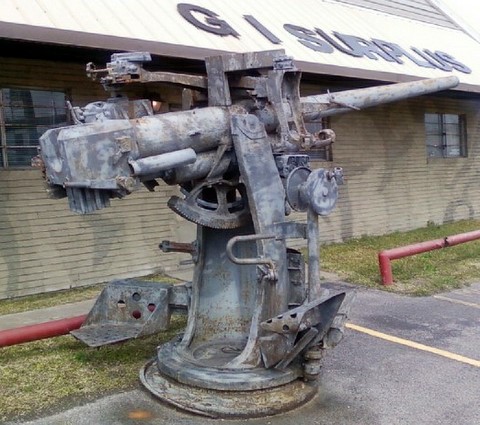
But it’s some of the stuff not for sale, items on the hard-to-reach top shelf which really makes my trip worthwhile. These items included various guns, military garb and decorations, a sled that was dropped from a plane for soldiers trapped in the snow, and of course they have the missiles and the big gun outside. One could almost imagine loading that sucker up and putting a few new potholes in the middle of U.S. 90. Talk about mayhem! Of course, I would never do something like that. That’s just fantasy all you NSA, FBI and other more local agencies out there scouring the Internet for trouble makers.

I suppose that visiting GI Surplus helps bring out the little kid inside us, inside me. I used to love going to these stores when I was a child and I still like going every once in awhile.

Growing up with family whose lives were heavily affected by World War II, it shouldn’t be surprising that one of my favorite pastimes as a kid was playing soldier.

I would be occasionally fighting the Krauts, especially on the dunes of Algeria after watching the “Rat Patrol” on TV.

But most of my war was fought on some nameless island in the South Pacific against the Japanese. That’s where a couple of my uncles served during the war. My father also sailed in the North Pacific, to Russia, and he used to talk of his ship enduring Japanese fighters on the trip to Vladivostok. I suppose some of the younger people, now parents, who grew up without any close family members who were sent to war might be aghast at such play. But then, what would you want your kids to pretend they are when they’re playing, stockbrokers? Bernie Madoff perhaps?

You would think with such a background and such a lifelong fascination with things military and war-oriented that I would have been a gung-ho type in the service. You would think wrong.

I was part of the Vietnam Era-Post Vietnam military and I guess, perhaps, I might have been a little bit of a stereotype of that time. I would grow my hair, beard, mustache or anything else I could grow to the limit. I was a bit of a slob. But the thing was, I performed my job very well and my superiors would let me slide on my appearance most of the time. It was all teenage rebellion as I joined the Navy in my teens. I was also touched by the anti-war movement. Sometimes we were treated like s**t by the civilians and so I took it out on the establishment. I know. It was kind of dumb. But I was lucky that I was so diligent in performing my job. I managed to escape Captain’s Mast or perhaps even the brig on several occasions.

The truth is, the military has been an important part of my life, especially in the first 25 or so years. I was surrounded by World War II veterans as a kid. Later as a reporter, I interviewed many who fought in that war. Also, my Dad was in the Merchant Marine during that war. Two of my older brothers served in the Navy before me in the early to mid-1960s, one brother spent a tour in Vietnam.

So I come by my military fascination  honestly. I also like looking at and firing big things which go “boom.” I’m 54 years old right now, so I don’t expect to change. At least for that part of said intrigue, I won’t grow up either Mr. Pan.

Empire or not, read this book

Is the United States of America an empire?

One could have a lot of fun and spend a considerable amount of time debating, researching, learning or whatever one might fancy in an effort to determine an answer to that question. Even then, ultimately, an answer could be lacking.

Author Robert D. Kaplan, national correspondent for the Atlantic Monthly magazine, raises this question which keeps popping up from time-to-time in our American discourse, in his book “Imperial Grunts.” But probably more important Kaplan writes in his book that today’s irregular U.S. military forces — the Marines and special forces — are an extremely capable and amazing instrument of a foreign policy whether intentionally or not crowns the American Empire.

Kaplan travels to global spots such as Mongolia, the Philippines, Colombia, Yemen, Afghanistan and Iraq where he looks at how the nation-building that U.S. special military forces are doing is as central to empire-building as military might. For those who thought “winning the hearts and minds” of a people ended after U.S. troops tried it in Vietnam, Kaplan delivers a more modern view of how this is being done as routine military fare.

Empire and nation-building, foreign policy and the George W. Bush-era version of military usage, however, are not as important and as aptly portrayed in this book than the author’s insightful exposition of the mostly young men who are at the heart of the new American military.

Kaplan draws the distinction between the “Big Army,” in which tons of regulations and layers of bureaucracy rule their world and the small teams and ease of operation which is the hallmark or the U.S. Army special operations. At the very heart of the latter is a society of soldiers ranging in rank from major down to senior non-commissioned officers — traditionally from the religious South or U.S. Heartland — whose most important attributes are their ability to adapt and adjust than strictly their use of M-4s or explosives. The special operators’ penetrating knowledge of local peoples who they must both teach and sometimes fight is also an important aspect of the American arsenal. As one special forces soldier in Afghanistan said of the Afghans: “These people like guns and fighting. Give them beer and a mobile home and they’d be just like us.”

Also very different in books about today’s military, Kaplan presents an almost uncensored view not seen in most media of the U.S. national guard troops who also serve as special operators. These citizen-soldiers are more open about their view of the military world because it is not their full-time job. One guardsman, for instance, said his civilian job was just a way he could pay for his special forces habit.

There are a number of Kaplan’s conclusions of which I am either unsure of or with which I disagree. But this is one of the best books I have read about today’s soldiers. I suppose my reason for saying so has to do with my past experience covering the Army as a reporter. Kaplan had the luxury — not a very apt word if you read about some of his lodging in the book — of accessing high-ranking SF types who helped him into some otherwise difficult places to report on these soldiers. Once he got to these places he was on his own and had to win the trust of the operators. But he also was able to stay with the soldiers for extended periods and build trust.

Thus, Kaplan had a more honest and open view of what was going on. This in sharp contrast to my having interacted with soldiers who were usually under the watchful eye of some public information officer types. I did my best but you can guess what makes much better reading.

If you are looking for their opinions of what the soldiers of the empire-or-not do, this is the book. If you want to know about their feelings for things other than work, then you should look elsewhere.

A best picture race for an Oscar and the surrounding hoodeleyap

It’s the day after the primary elections here in Texas. I hope everybody’s candidate won. Think about that for a minute.

These days I don’t make it to the movies much anymore. I don’t know why. But I have been following all the buzz about a nominee for Best Picture at the Academy Awards this week. Of course, there is always some buzz surrounding the coveted of the coveted Oscars. It’s office politics, which I don’t like at all. So I sure as hell don’t like the office politics of the Oscars. This year in particular it’s disgusting — sort of — and I’ll tell you why if you don’t go off in a huff and leave what you are reading. Don’t worry, I’ll get there soon. Soon enough.

Most of the hoodeleyap (Hey, that’s a good word I just made up! It’s pronounced “WHO-del-e-yap,” only faster and means bodougleypot. “BO-doo-gul-e-pot”) concerning the Oscar for best director is over the 2/3rd’s computer-generated Avatar directed by James Cameron and Hurt Locker, which is directed by Cameron’s ex-wife Kathryn Bigelow.

Certainly, the media has made much of possible Oscars going to one of a divorced, but friendly, ex-couple who directed these films. Also, if Bigelow wins she will be the first woman to win the hideous-looking gold statuette for directing. Other sideshows to this story have likewise appeared to build up the hype for the Oscars and their potential winners:

  • While Hurt Locker — a story about an explosives demolition unit on a tour of duty in Iraq — has received critical acclaim the film also has drawn the ire of some Iraq veterans and active duty soldiers. They say the thriller doesn’t realistically portray soldiers doing their job, that it makes troops seem reckless and has other less-than-authentic aspects. This is even though Defense Secretary Robert Gates liked and recommended the movie while the military withdrew its assistance in the film in 2007 for unflattering portrayals of soldiers. Uh, you want reality? Go watch C-SPAN.
  • Yesterday Nicolas Chartier, one of the Hurt Locker‘s producers, was barred from the Oscar presentations for e-mailing messages to Academy members that ask for their votes for the film. No tux and red carpet for you, Mr. Chartier!
  • Today an Army master sergeant and bomb expert filed a suit against the film’s screenwriter, who is also one of the producers, for exploiting the sergeant’s service. The soldier claims the film is based on his experiences and that he coined the term “Hurt Locker.” Maybe he did. Maybe he didn’t. Maybe he halfway did.

Well, like “they” say, no publicity is bad publicity. Or maybe it is. But it’s Oscar time! Break out the 40-year-old single malt and the good silverware! That’s not in my case of course, and I most likely, more than most likely won’t be watching the Oscars. But I have to admit, I would like to see the movie, the Hurt Locker.

It’s another one of those far-off Hollywood happenings — the aforementioned hoodeleyapthat don’t really mean anything or matter in the least to the average beer-swilling and gun-toting American who washes up once a week and goes to the picture show. But I suppose all the hype makes us want to watch the car wrecks on the big screen which will, in this case, be big improvised explosive devices that go “boom.”

Wrestling with old habits at the ballot box

My daddy used to say that if a person didn’t vote then that person didn’t have a right to complain about how things turn out in our government. Of course, as Pop well knew, I could complain regardless of whether I voted. But I got his drift.

I thought about this while heading to vote this morning at Central Medical Magnet School in Beaumont. For probably the first time I can remember in an election, I faced a real dilemma although some might call it “choice.” That choice was whether to vote in the Republican or Democratic primary.

The decision of in which primary to vote was as simple as a kindly voting clerk lady saying “Democrat or Republican” when I walked into the boys’ gymnasium where voting was held. It’s funny, that smell of sweat from adolescent boys seems to never fade.

My dilemma stemmed from one race, which was the Republican primary for Texas governor that pits established U.S. Sen. Kay Bailey Hutchison and Tea Partier Debra Medina against incumbent Gov. Rick “And His Hair Was Perfect” Perry.

Now as regular readers know, I have no desire to see any of those three — or any three that I can think of — Republicans elected Texas governor. But like other Democrats in the state who really DON’T want Rick “Secede from the Union” Perry reelected, I considered briefly voting for Hutchison who is running uncomfortably behind Perry. A Democratic vote for Hutchison, according to pundits like Texas Monthly’s Paul Burka, might — might — force Perry into a runoff. There the governor could be embarrassed and his campaign weakened. It certainly would mean spending more money, what with another election. All of this could conceivably help the Democratic candidate, likely former Houston mayor Bill White, beat Perry in November.

In the end though, I could not do as one of my favorite bloggers, Eileen Smith of In the Pink: Texas Monthly, said she ultimately did which is vote on the Republican ballot.

When the nice lady said: “Democrat or Republican” this morning I headed straight for the Democrats. Old habits are difficult to quit, like smoking and watching porn. I have always voted the Democratic ballot. The first time was to vote for Jimmy Carter and, yes I am proud to say I did vote for him. No one said our presidents can’t have their faults. (See George W. Bush)

Four more years of Rick Perry is not a prospect I care to think of on a nice pre-spring day on which I heard about three or four great songs in a row on the radio. But I have pretty much been a Democrat all my life and there are just some things I won’t do, like wear a Snuggie, sing “Feelings” in a karaoke bar and vote in a Republican primary. It was a difficult choice to make but it was pretty simple there in the end.