What is all this weird stuff outside?


This weird machine is sitting outside my apartment complex. With its tracks for moving around and its upward tilt of what appears to be pipes, it somewhat reminds me of a rocket launcher. Actually, I think it is kind of a high-tech roto-rooter. A pipe is going into the ground and there is a tiny screen on the operator’s console. Perhaps it is inserting a tiny camera through the underground water pipes. I do know that they are working on water pipes because all of the areas around the water meters from my apartments up past the next block are dug up. Or at least I suppose they are working on the water lines.

Then again, with the looks of this, I’m not sure what they are digging for. This outline in the hole they dug out front bears a slight resemblance to a body outline. Oh come on! If you look hard enough you can see it! Maybe they are really digging for Jimmy Hoffa outside. After all, I read that the FBI is looking for Hoffa’s body again. Although, you don’t see many instances of city water crews digging for long-dead bodies, especially without any police in sight.

Maybe I’ll just ask them what kind of work they are doing outside my apartment. But then, what fun would that be?

Prosecute this


It is funny how someone can, all of a sudden, ponder a phrase that he or she has heard all of their lives but never gave the words much thought. I noticed a “no trespassing” sign on an apartment complex this morning as I walked by. Small, red letters at the bottom of the sign said:

“Violators will be prosecuted to the full extent of the law.”

I never really thought about just what being prosecuted to the full extent of the law meant until today. It’s just something I have always heard and never questioned. A legal definition of “prosecute” is:

“v. 1) in criminal law, to charge a person with a crime and thereafter pursue the case through trial on behalf of the government. This is normally the function of the District Attorney and the U.S. Attorney in federal criminal cases. 2) to conduct any legal action by a lawyer on behalf of a client, including both civil and criminal cases, but most commonly referring to prosecution for crimes.”

So I don’t know if you get what I am leading up to but basically, in a sense of the word, the property owner does not really have much of a dog in the hunt as for actually prosecuting the crime. They can file a complaint. They can ask the district attorney to prosecute the crime to the full extent of the law. But the district attorney doesn’t have to, nor sometimes does he or she want to, prosecute someone to the fullest extent of the law.

Also puzzling is the wording “full extent of the law.” I would think if someone has had a crime committed against them or if there was a possibility of a crime happening to them that they wouldn’t want the perpetrator prosecuted to the “least extent of the law,” or the “medium extent of the law.” It just seems “full extent” is sort of a superfluous notion.

Even if the sign leaves off the full extent phrase and just proclaims that the violator will be prosecuted, well we would be right back where I began with the D.A. I have known some D.A.s over time of whom police officers have been downright scornful because of their unwillingness to prosecute cases. It seems having a sign that says: “Violators might be prosecuted,” or “Violators might be prosecuted if the D.A. is not a jackass,” may be more accurate. The value of such phrases as a deterrent, of course, might be questionable.

I am sure those who know the law much more than me (or even those who don’t know) might question my questioning of the concept. But the truth is, it really isn’t that important. Thus, I don’t really care.
Tony Snow's "Ed Muskie moment"


Contrary to what many who know me might think, I really don’t like being cynical. That is, at least all the time. I would rather give people the benefit of the doubt especially in cases in which they have suffered some hardship.

My reference is to White House Press Secretary Tony Snow and his show of emotion — what he called his “Ed Muskie moment” — Monday during his first on-air press briefing. For those of you who might not remember or know, Ed Muskie was a candidate for the Democratic presidential nomination in 1972. In defending his wife from a newspaper attack, Muskie apparently wept while speaking outside the newspaper’s office while campaigning. He later claimed to be wiping snowflakes from his eyes.

Snow was asked by a reporter yesterday about a yellow wristband that he wears. It was during the following exchange that he had to pause a couple of times to regain his composure:

“MR. SNOW: I had cancer last year. And having cancer, it’s one of these things — thank Terry Hunt for having provided — I lost my old one when I was in the hospital having my last cancer surgery. It’s going to sound stupid, and I’ll be personal here, but — just having gone through this last year — and I said this to Chris Wallace — was the best thing that ever happened to me. It’s my Ed Muskie moment. (Laughter.) I lost a mother to cancer when I was 17, same type — same type, colon cancer. And what has happened in the field of cancer since then is a miracle.

“I actually had a chance to talk today with Lance Anderson [sic] about this. You know, it’s one of these things where America — whatever we may say about a health care system, the technologies that were available to me that have me standing behind the podium today, where a doctor who said, you don’t have to worry about getting cancer, just heartburn, talking to these people — (laughter) — that’s a wonderful thing. And I feel every day is a blessing.”

Snow later corrected his mistake referring to Lance Armstrong as Lance Anderson.

The press secretary’s emotion appeared genuine. Maybe it was genuine. I would have liked to have think so. But you can’t escape the fact that Snow is a pretty slick performer. And there appears to be no scheme — no matter how low, idiotic, or illegal — that his boss’ administration will not concoct.

All I can say is that I am sorry that I have to question someone’s show of feelings for what is a truly emotional subject. But Gee Dubya and his pals have raised my cynicism to an all-time high.

The number you have dialed …


Perhaps it is all the talk about the government listening or tracking domestic phone calls, but my obsession today is songs that contain phone numbers.

The song “Jenny” by Tommy Tutone probably comes to mind for those of you out there who remember the 1980s (all six of you). If you are like me you can’t remember a phone number that you need to dial even though you looked at the number a nanosecond ago. But 867-5309? It’s stuck into my head like a toupee that’s been Super-glued.

Of course songs about phone calls or that include phone numbers have been around since Alexander Graham Bell said: “Mr. Watson, come here, I want you.” I still think it’s a rather unfortunate choice of words. Not that there’s anything wrong with it.

The old Glenn Miller tune “Pennsylvania 6-5000” — way, way before my time — comes to mind. Then Wilson Picket probably implanted “634-5789” in people’s brains back in the ’60s just as Tutone did. As a matter of fact, I remembered the song even though I couldn’t remember the number or the title and still was able to find the song’s name:

“If you need a little lovin’
Call on me all right
If you want a little huggin’
Call on me baby, mmmmmm
Oh I’ll be right here at home

All you got to do is
Pick up your telephone
And dial 634-5789
(What’s my number)
634-5789.”

That’s right, baby. A little lovin,’ a little huggin.’ That’s all I need. Oh, and bring over a pizza and some beer, will ya?

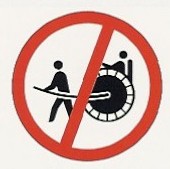
Rickshaw, monkeys and other tales


Why no rickshaw? It is like the tongue twister “Rubber buggy baby bumper” coming to me a short while ago while out for a walk. I can’t explain it.

Actually, I just came across the sign while searching for something else. I got the picture, of all places, off the Web site of the South Africa Department of Transportation. It is one of their warning signs. I’ve never been to South Africa. But I never really thought of it as a place with rickshaws. At the very least, I’ve never thought of South Africa as a place with a need for “No Rickshaw” signs. It’s a rather quaint idea to me but it might make perfect sense to someone in South Africa.

I wonder what it would be like to be filthy rich and have your very own rickshaw driver? What would you pay him or her? How would you interview a prospective driver? “Hey take me for a spin around the block.” What would be the speed one would expect a rickshaw driver to run while pulling you somewhere? I just have a lot of questions about rickshaws. That’s all I’m saying.

I would have expected to see rickshaws in the Philippines but I never saw any there. Why would I expect to see rickshaws there? Is it because I think all Asian countries have rickshaws and a never-ending supply of laundry workers? No. It is because the Philippines had some really strange modes of transportation. Like the Jeepneys. They were originally pimped out U.S. military jeeps left over from World War II. Also among the ways to get around when I was in the Philippines were motorcycle sidecars.

Riding a sidecar, or even being around a sidecar, was taking one’s life into their own hands. But then most every taxi ride I had in the Philippines was hair-raising. Perhaps the scariest ride was one I took one afternoon from the Subic Bay Navy Base to the Cubi Point Naval Air Station. The road going to Cubi point was a winding mountain road that had no railings to separate the road from what was quite a large drop-off. As we were riding along in this Toyota Corolla taxi, a monkey ran out in front of us. The driver, being cute I suppose, steered momentarily toward the monkey as if he was going to hit it and laughed. I didn’t find it very funny.

Cubi Point has an interesting history, by the way. According to the official U.S. Navy Seabees history:

“Civilian contractors, after taking one look at the forbidding Zambales Mountains and the maze of jungle at Cubi Point, claimed it could not be done. Nevertheless, the Seabees proceeded to do it! Begun in 1951 at the height of the Korean War, it took five years and an estimated 20-million man-hours to build this new, major Navy base. At Cubi Point Seabees cut a mountain in half to make way for a nearly two-mile long runway. They blasted coral to fill a section of Subic Bay, filled swampland, moved trees as much as a hundred and fifty feet tall and six to eight feet in diameter, and even relocated a native fishing village. The result was an air station, and an adjacent pier that was capable of docking the Navy’s largest carriers.”

I bet it would have been a hell of a ride up the mountain in a rickshaw.